I said; I am always looking to make the world a better place.
I was told...
: The only way to be effective at that is to start inside yourself, then work locally.
: It is darn hard to truly help people who are far away if you don't help those nearby.
: The effect of your local success will ripple, and help more and farther than you imagine.
Sunday, January 28, 2007


Thursday, January 25, 2007
The ARC
I have been spending most of my writing energy at HUG's new WIKI.
Using the same software as Wikipedia, we are inviting anyone interested to help us design a kind of agricultural neighborhood. We call it the ARC project (for Agricultural, Resilient Communities) (or Anti Retirement Communities.) I expect an ARC community to have a very pleasant, down to earth lifestyle, a robust economic base, and very low energy consumption.
It has been keeping us awake nights for a while as we try to put into words all the synergies that the ARC will pull together.
Using the same software as Wikipedia, we are inviting anyone interested to help us design a kind of agricultural neighborhood. We call it the ARC project (for Agricultural, Resilient Communities) (or Anti Retirement Communities.) I expect an ARC community to have a very pleasant, down to earth lifestyle, a robust economic base, and very low energy consumption.
It has been keeping us awake nights for a while as we try to put into words all the synergies that the ARC will pull together.
Friday, January 05, 2007
Saturday, December 30, 2006
Search for life
It is fun to look up the definition of words. Usually I learn something about a word's evolution that surprises me and sheds light where I didn't expect it.
One example is the word "sentience". Normal usage often refers to intelligent consciousness. Wikipedia points out that it refers to the ability to sense. For me, that made a bunch of things fall into place.
The closer one looks at the makeup of matter, the more one realizes that everything is made out of communications. Photons, gluons, gravitons and the like are the communications between particles. They are the glue that holds matter together. They are the forces that hold matter apart. Every piece of matter is sensing its neighbors.
Everything is sentient.
I suspect that if we look closer, we will find that it is plenty intelligent too.
We don't need to search the universe for sentient life.
Life pervades us at every level.
One example is the word "sentience". Normal usage often refers to intelligent consciousness. Wikipedia points out that it refers to the ability to sense. For me, that made a bunch of things fall into place.
The closer one looks at the makeup of matter, the more one realizes that everything is made out of communications. Photons, gluons, gravitons and the like are the communications between particles. They are the glue that holds matter together. They are the forces that hold matter apart. Every piece of matter is sensing its neighbors.
Everything is sentient.
I suspect that if we look closer, we will find that it is plenty intelligent too.
We don't need to search the universe for sentient life.
Life pervades us at every level.
Thursday, December 21, 2006
The need to creed
It is starting to make sense.
An anthropologist type guy pointed out to me that religion is very important to our survival. The main thing that sets us apart from other species is our ability to build large complex societies. That is what drives our success and our population boom in the last ten thousand years.
To pull a group of people together into a functioning group requires a set of common beliefs. Common beliefs are the glue that holds the social body together. A strong passionate set of beliefs will create a strong passionate group.
It is little wonder that we have genes that make us yearn for cosmic truth. We are hungry for a sense of some truth bigger than we are; a truth that will inspire others who will then adopt it with passion.
We are genetically programmed so that each time someone accepts one of our truths, we get a little reward in our brains. That creates bonds between us in the same way that the hormone oxytocin creates bonds when we share physical pleasures.
Our need to creed creates strong and vibrant social bodies.
Sunday, December 10, 2006
Fun time, fun camera
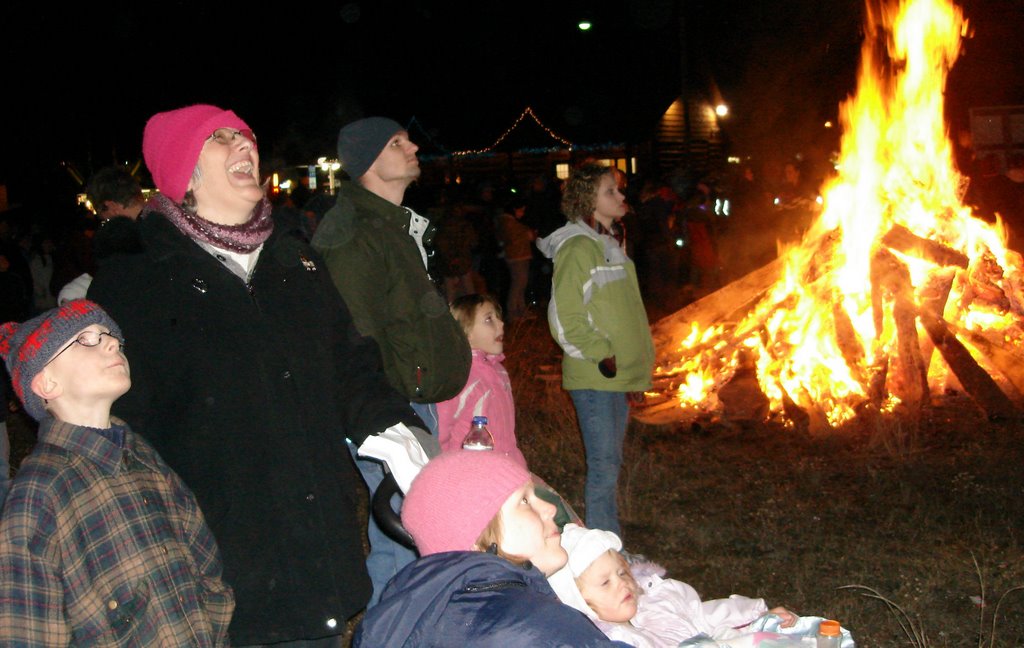
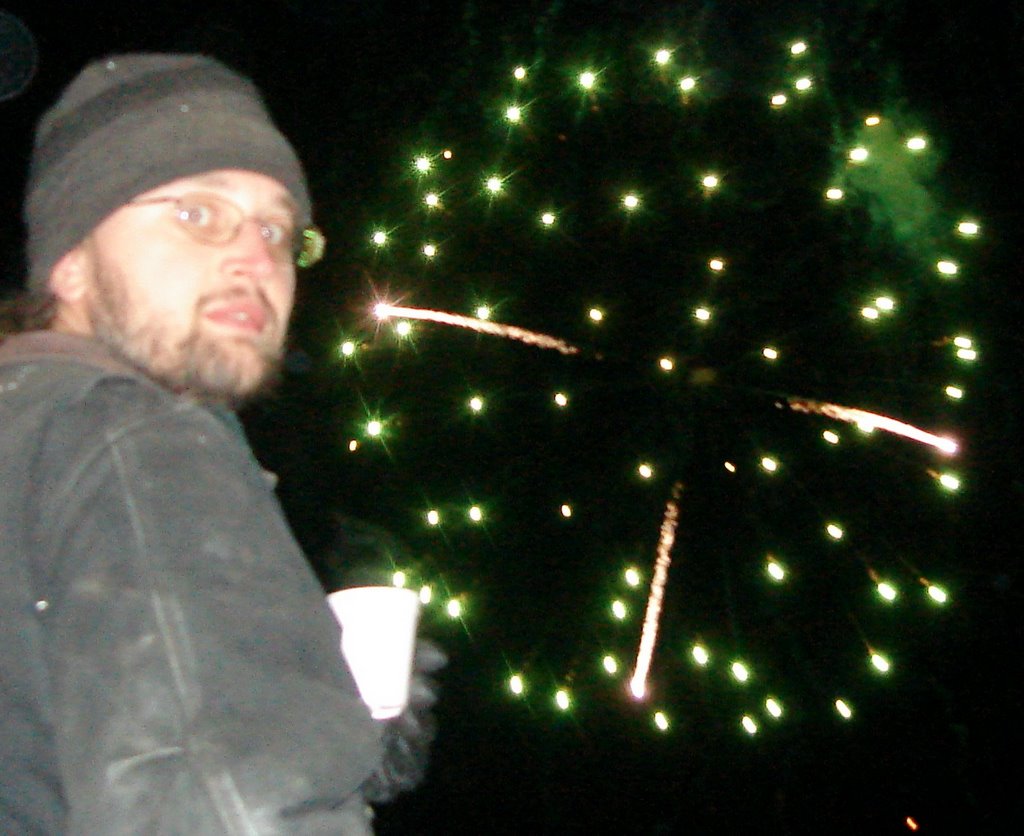
I have to marvel at how well the little pocket camera works with a combination of front light and back light. We were at Pine River's winter festival last night and got lots of shots like these...
Saturday, November 25, 2006
Tiny view
Compared to the silent knowledge of meditation, I find that any attempt to pull God into religion, no matter how well it is done, is somewhat impoverishing. Similar to the fact that words are inadequate to describe the trancendent, pulling God into any form or organization is inherently limiting.
It is also the only way we can know anything. We pick a point of view; create words as handles to manipulate our concept; and think of that little piece of the all as something real.
It is also the only way we can know anything. We pick a point of view; create words as handles to manipulate our concept; and think of that little piece of the all as something real.
Sunday, November 19, 2006
I'm the pupil
Prayer is talking.
Meditation is LISTENING.
Which one helps us learn more?
Lucid meditation, like lucid dreams, lets you ask questions to change the course of the teaching.
It is a two way conversation; master and pupil.
Meditation is LISTENING.
Which one helps us learn more?
Lucid meditation, like lucid dreams, lets you ask questions to change the course of the teaching.
It is a two way conversation; master and pupil.
Thursday, November 02, 2006
Pass it around
After seeing this quote on George's blog, I decided it really is time to recirculate this wisdom to everyone in our nation.
"A great nation is like a great man:
When he makes a mistake, he realizes it.
Having realized it, he admits it.
Having admitted it, he corrects it.
He considers those who point out his faults
as his most benevolent teachers.
He thinks of his enemy
as the shadow that he himself casts."
--Tao Te Ching
"A great nation is like a great man:
When he makes a mistake, he realizes it.
Having realized it, he admits it.
Having admitted it, he corrects it.
He considers those who point out his faults
as his most benevolent teachers.
He thinks of his enemy
as the shadow that he himself casts."
--Tao Te Ching
Monday, October 30, 2006
The power to predict
Perhaps the most practical description of intelligence is “the power to predict”. So far, I can’t think of any example of intelligence that does not fit that definition. Prediction seems to be the whole reason for it to exist.
You and I seem to live in the bizarre situation where we are constantly traveling in a direction we cannot see. We have to steer, but we can only see where we have already been. In order to travel well, we have to make intelligent guesses about how to steer, based on what we just passed; lines on the road, the nature of obstacles we almost hit, what our neighbors are hitting. This must be a fun game because judging from the crowds it is very popular. One strategy to do well in this game is to develop intelligence.
Now consider a being that lives outside of time. This being can view time as just another dimension in space. She could “see” history at a glance. Past and future have no meaning. Different times are simply different locations on a landscape.
This being has no need for intelligence; there is nothing to predict. She would seem to us to be super intelligent and wise and knowledgeable. To us she would appear to be omniscient and omnipresent
You and I seem to live in the bizarre situation where we are constantly traveling in a direction we cannot see. We have to steer, but we can only see where we have already been. In order to travel well, we have to make intelligent guesses about how to steer, based on what we just passed; lines on the road, the nature of obstacles we almost hit, what our neighbors are hitting. This must be a fun game because judging from the crowds it is very popular. One strategy to do well in this game is to develop intelligence.
Now consider a being that lives outside of time. This being can view time as just another dimension in space. She could “see” history at a glance. Past and future have no meaning. Different times are simply different locations on a landscape.
This being has no need for intelligence; there is nothing to predict. She would seem to us to be super intelligent and wise and knowledgeable. To us she would appear to be omniscient and omnipresent
Tuesday, October 17, 2006
Not consumers; Participators
Society is the brain. Individual people are the neurons.
As a student of neural networks, I was fascinated when the internet first got popular. This meant that the giant brain that we live in suddenly became much more connected. In neural nets, that usually means much smarter and able to learn much faster. I was wondering how that might manifest in society.
There is a pwerful new movement afoot. The awesome power of its timeliness struck me when I began to hear it explained this way...
People are so tired of being "consumers".
They want to be producers.
The author of an upcoming book "We-Think" phrases it this way
Google paying close on £900m for Youtube, a profitless business little more than a year old. Wikipedia continues to draw more traffic than much more established media brands, employing hundreds more people. Open source programmes such as Linux insistently chip away at corporate providers of proprietary software. Immersive multi user computer games, such as Second Life, which depend on high levels of user participation and creativity are booming. Craigslist a self help approach to searching for jobs and other useful stuff is eating into the ad revenues of newspapers. Youth magazines such as Smash Hits have been overwhelmed by the rise of social networking sites such as MySpace and Bebo. What is going on?
We-Think: the power of mass creativity is about what the rise of the likes of Wikipedia and Youtube, Linux and Craigslist means for the way we organise ourselves, not just in digital businesses but in schools and hospitals, cities and mainstream corporations. My argument is that these new forms of mass, creative collaboration announce the arrival of a society in which participation will be the key organising idea rather than consumption and work. People want to be players not just spectators, part of the action, not on the sidelines.
Check out his pre release book and help him edit it.
As a student of neural networks, I was fascinated when the internet first got popular. This meant that the giant brain that we live in suddenly became much more connected. In neural nets, that usually means much smarter and able to learn much faster. I was wondering how that might manifest in society.
There is a pwerful new movement afoot. The awesome power of its timeliness struck me when I began to hear it explained this way...
People are so tired of being "consumers".
They want to be producers.
The author of an upcoming book "We-Think" phrases it this way
Google paying close on £900m for Youtube, a profitless business little more than a year old. Wikipedia continues to draw more traffic than much more established media brands, employing hundreds more people. Open source programmes such as Linux insistently chip away at corporate providers of proprietary software. Immersive multi user computer games, such as Second Life, which depend on high levels of user participation and creativity are booming. Craigslist a self help approach to searching for jobs and other useful stuff is eating into the ad revenues of newspapers. Youth magazines such as Smash Hits have been overwhelmed by the rise of social networking sites such as MySpace and Bebo. What is going on?
We-Think: the power of mass creativity is about what the rise of the likes of Wikipedia and Youtube, Linux and Craigslist means for the way we organise ourselves, not just in digital businesses but in schools and hospitals, cities and mainstream corporations. My argument is that these new forms of mass, creative collaboration announce the arrival of a society in which participation will be the key organising idea rather than consumption and work. People want to be players not just spectators, part of the action, not on the sidelines.
Check out his pre release book and help him edit it.
Wednesday, October 11, 2006
Observations about anger
When you have anger welling up inside you, It reduces the clear headed thinking it takes to deal with people around you.
It is good to discuss what bugs you and get into the daylight. Keeping anger under-communicated is very similar to nutrients being held in anaerobic conditions. It festers and stinks and is toxic to our kind of life. Way better to expose it to just enough fresh air to let friendly critters break it down into healthy soil.
Eventually it will nourish you.
It is good to discuss what bugs you and get into the daylight. Keeping anger under-communicated is very similar to nutrients being held in anaerobic conditions. It festers and stinks and is toxic to our kind of life. Way better to expose it to just enough fresh air to let friendly critters break it down into healthy soil.
Eventually it will nourish you.
Monday, October 09, 2006
Tell your story
Have you ever wondered why fame and fortune are usually in the same context? It is no accident that the two are linked. When you ask “What is she famous for?” you are asking “What is her theme?”
You don’t have to be a superstar to make good use of the principles behind fame and fortune. It is very basic and applies well to your job, your business, and your personal life.
People love to help. If they think you have a theme, every time they run across something that reminds them of that theme, they will think of you. They will buy you gifts or send you information associated with that theme. It makes them feel good about you, and therefore talk well about you.
Some experts say, the most important part of running your business (perhaps your life too) is telling your story. It is a valuable skill to be able to explain what you do and why, fast enough and clearly enough to get the message through before your listener runs out of attention span.
One important version is your elevator story. That is the short one that can get the point across in the time it takes to ride an elevator.
Practice counts. Nearly everyone you talk to is another opportunity to fine tune your story. You want your story to hit the target (the listener’s psyche), so you sharpen and hone it to a fine edge, able to cut through the mental noise and piles of debris left by all the other stories.
Repetition counts. It is just as important for YOU to hear your story over and over as it is for anyone else. It helps create theme and focus in your life. It helps you define (and thus fine tune) your sense of purpose.
Your story helps create a point of view and a platform to act from. It also becomes a moral force in your life. Each time you tell your story, you are listening. You decide if you like what you hear. You feel the reactions from your listener. You fine tune it to better serve you and your listener.
The quality of your story defines the quality of your life.
Are you making yours better?
You don’t have to be a superstar to make good use of the principles behind fame and fortune. It is very basic and applies well to your job, your business, and your personal life.
People love to help. If they think you have a theme, every time they run across something that reminds them of that theme, they will think of you. They will buy you gifts or send you information associated with that theme. It makes them feel good about you, and therefore talk well about you.
Some experts say, the most important part of running your business (perhaps your life too) is telling your story. It is a valuable skill to be able to explain what you do and why, fast enough and clearly enough to get the message through before your listener runs out of attention span.
One important version is your elevator story. That is the short one that can get the point across in the time it takes to ride an elevator.
Practice counts. Nearly everyone you talk to is another opportunity to fine tune your story. You want your story to hit the target (the listener’s psyche), so you sharpen and hone it to a fine edge, able to cut through the mental noise and piles of debris left by all the other stories.
Repetition counts. It is just as important for YOU to hear your story over and over as it is for anyone else. It helps create theme and focus in your life. It helps you define (and thus fine tune) your sense of purpose.
Your story helps create a point of view and a platform to act from. It also becomes a moral force in your life. Each time you tell your story, you are listening. You decide if you like what you hear. You feel the reactions from your listener. You fine tune it to better serve you and your listener.
The quality of your story defines the quality of your life.
Are you making yours better?
Saturday, September 30, 2006
The mandate to create
It is usually a compliment to tell someone that they are creative. At least in our society, (and I suspect in our soul) we have a drive to create. Usually if we have an innate drive, there is a deep reason that helps us survive.
So why do we seem to have a mandate to create?
So why do we seem to have a mandate to create?
Thursday, September 28, 2006
Synchronicity
It is vaguely similar to déjà vu, but happens much more often. The last day or two has almost been weird how many things appeared just minutes after I wondered about them. It goes beyond mere coincidence. Carl Jung called it synchronicity; a manifestation of the collective unconscious.
Two typical examples:
: An advisor was shopping for a tractor for me. He said he would keep in touch, but I hadn’t heard a word from him. I also hadn’t even thought about him for a week and a half, until this afternoon when I suddenly thought about him strongly. Where is he? Should I look him up? A half hour later he showed up in person with the answer we had been hoping for.
: I had been wondering this afternoon how much a certain employee was making and if we should consider a raise in salary. I was just about to ask Lynn to look it up as I clicked on my next email. There in the email was the specific information I was just about to ask for.
Other incidents in the last 24 hours involved magazine covers boldly announcing the weird topic I just mentioned. Video programs focused on a topic I just brought up, etc.
One of Jung's favorite quotes on Synchronicity was from Through the Looking-Glass by Lewis Carroll, where the White Queen says to Alice: "It's a poor sort of memory that only works backwards".
Two typical examples:
: An advisor was shopping for a tractor for me. He said he would keep in touch, but I hadn’t heard a word from him. I also hadn’t even thought about him for a week and a half, until this afternoon when I suddenly thought about him strongly. Where is he? Should I look him up? A half hour later he showed up in person with the answer we had been hoping for.
: I had been wondering this afternoon how much a certain employee was making and if we should consider a raise in salary. I was just about to ask Lynn to look it up as I clicked on my next email. There in the email was the specific information I was just about to ask for.
Other incidents in the last 24 hours involved magazine covers boldly announcing the weird topic I just mentioned. Video programs focused on a topic I just brought up, etc.
One of Jung's favorite quotes on Synchronicity was from Through the Looking-Glass by Lewis Carroll, where the White Queen says to Alice: "It's a poor sort of memory that only works backwards".
Thursday, September 21, 2006
A little epiphany this morning…
One man’s order is another man’s entropy.
Entropy is a tendency toward disorder. Life tends to reverse entropy (at least locally). It tends to create order.
Nature had spent millions of years developing intricate communities of interactive plants, animals, minerals and fluids. She built up diversity so the bio-communities can be robust. Her complexity is actually a high level of order.
Historically, our western civilization has viewed nature as chaos and entropy. It needed to be civilized and ordered. We proceeded to eliminate pests and clear fields, reducing the complexity and diversity that had been built up.
Nature’s order seemed like entropy to us.
Our sense of order is entropy to nature.
Entropy is a tendency toward disorder. Life tends to reverse entropy (at least locally). It tends to create order.
Nature had spent millions of years developing intricate communities of interactive plants, animals, minerals and fluids. She built up diversity so the bio-communities can be robust. Her complexity is actually a high level of order.
Historically, our western civilization has viewed nature as chaos and entropy. It needed to be civilized and ordered. We proceeded to eliminate pests and clear fields, reducing the complexity and diversity that had been built up.
Nature’s order seemed like entropy to us.
Our sense of order is entropy to nature.
The basis of toughness
It is hard to appreciate how much my mindset has changed, until I take the time to look at its evolution in the last 8 years or so. This morning I was contemplating lessons I and those near me have been learning the last few years.
My personal relationship with the earth had been minimal until we started HUG. From then on, the projects we worked on pulled me closer to understanding the minerals and how they interact with each other. Then we had expert after expert show up in our lives to teach us about plants and the soil food web.
One outstanding lesson from all this is DIVERSITY.
Laser focus can get certain things done with incredible efficiency, but typically such focus is fragile and can only exist with the support of successful community. Diversity makes communities tough and resilient, and more productive.
Don't forget, communities come in all sizes. They exist in molecules, soil, plants, people.
My personal relationship with the earth had been minimal until we started HUG. From then on, the projects we worked on pulled me closer to understanding the minerals and how they interact with each other. Then we had expert after expert show up in our lives to teach us about plants and the soil food web.
One outstanding lesson from all this is DIVERSITY.
Laser focus can get certain things done with incredible efficiency, but typically such focus is fragile and can only exist with the support of successful community. Diversity makes communities tough and resilient, and more productive.
Don't forget, communities come in all sizes. They exist in molecules, soil, plants, people.
Sunday, September 17, 2006
Passion!
Kate sent me this little inspirational / motivational video.
She said it was kind of cheesey, but it made her think of me.
Thanks Kate. I feel like high quality parmesan. (which is really good at our local co-op)
Even though it is mostly just music and printed words, after watching it several times, I still get goosebumps from it. I have always been a sucker for good self motivational stuff.
I also put it on the LINKS sidebar.
She said it was kind of cheesey, but it made her think of me.
Thanks Kate. I feel like high quality parmesan. (which is really good at our local co-op)
Even though it is mostly just music and printed words, after watching it several times, I still get goosebumps from it. I have always been a sucker for good self motivational stuff.
I also put it on the LINKS sidebar.
Wednesday, September 06, 2006
War on Terra
Tonight, after reading some international news on the web, Lynn and I spent 20 minutes sampling news channels on TV. We marvelled at how shallow and easily manipulated american news really is. Very little interest in saving the planet; tons of talk about Iraq and the war on terror.
We thought we coined a new term when we asked "What about the War on Terra?"
The term sounded good enough to try to blog something clever about it. Just before starting to write, I googled the term.
"War on Terra" has 11 million hits, including a wikipedia entry.
We thought we coined a new term when we asked "What about the War on Terra?"
The term sounded good enough to try to blog something clever about it. Just before starting to write, I googled the term.
"War on Terra" has 11 million hits, including a wikipedia entry.
Saturday, September 02, 2006
Assignment
For the past week or so, as I wake up I find that in my sleep I have been designing houses of cob (a mixture of clay, sand and straw). It even happens during a short nap.
Perhaps the teacher is trying to tell me something.
Perhaps the teacher is trying to tell me something.
Subscribe to:
Posts (Atom)